
Governance-First AI: RBAC/ABAC, Audit Trails & Policy-Aware Access (Without Slowing Teams)
FEBRUARY 06, 2026
1. The Problem: Pain + Risk
Here's a scenario playing out in boardrooms worldwide: The AI pilot worked brilliantly. Now it's time to scale—and suddenly, security, legal, and compliance have questions. Who accessed what data? Can we prove it? What happens when the regulator asks?
The numbers are sobering. According to IBM's 2025 data, 13% of organizations experienced AI model or application breaches last year. Of those, 97% lacked proper AI access controls. The average cost of a data breach has climbed to $4.88 million globally—reaching $6.08 million in financial services alone.
of organizations experienced AI breaches last year. 97% lacked proper access controls.
The average cost of a data breach in the financial services sector in 2025.
Meanwhile, shadow AI is exploding. A 2025 Komprise survey found that 90% of IT leaders are concerned about shadow AI from a privacy and security standpoint, with nearly 80% having already experienced negative AI-related data incidents.
The core tension is clear: business teams want speed; security teams want control. Traditional approaches force a choice. Lock everything down, and innovation dies. Open the floodgates, and risk multiplies.
"We built amazing AI capabilities—then spent six months in audit purgatory because we couldn't explain who saw what."
— A Global CIOThis isn't a technology problem. It's a governance architecture problem.
2. What Good Looks Like: The Outcome
Imagine a different reality: AI systems where access decisions happen in milliseconds, policies update once and apply everywhere, and every interaction leaves a traceable record—without slowing anyone down.
This is what governance-first AI delivers:
Teams innovate freely within defined boundaries. No waiting for IT tickets. No bottlenecks at security review.
When regulators or auditors arrive, you don't scramble. The system already knows who accessed what, when, why, and under what policy.
Update a compliance rule once, and it propagates instantly across every application, every model, every user.
Organizations implementing AI-enhanced RBAC/ABAC capabilities report 75% fewer access-related security incidents. Healthcare institutions supporting HIPAA compliance through proper access governance have reduced compliance-related expenses by 30-45%.
The goal isn't control for control's sake. It's confidence—confidence to move fast because you know you're moving safely.
3. How It Works: High-Level Architecture
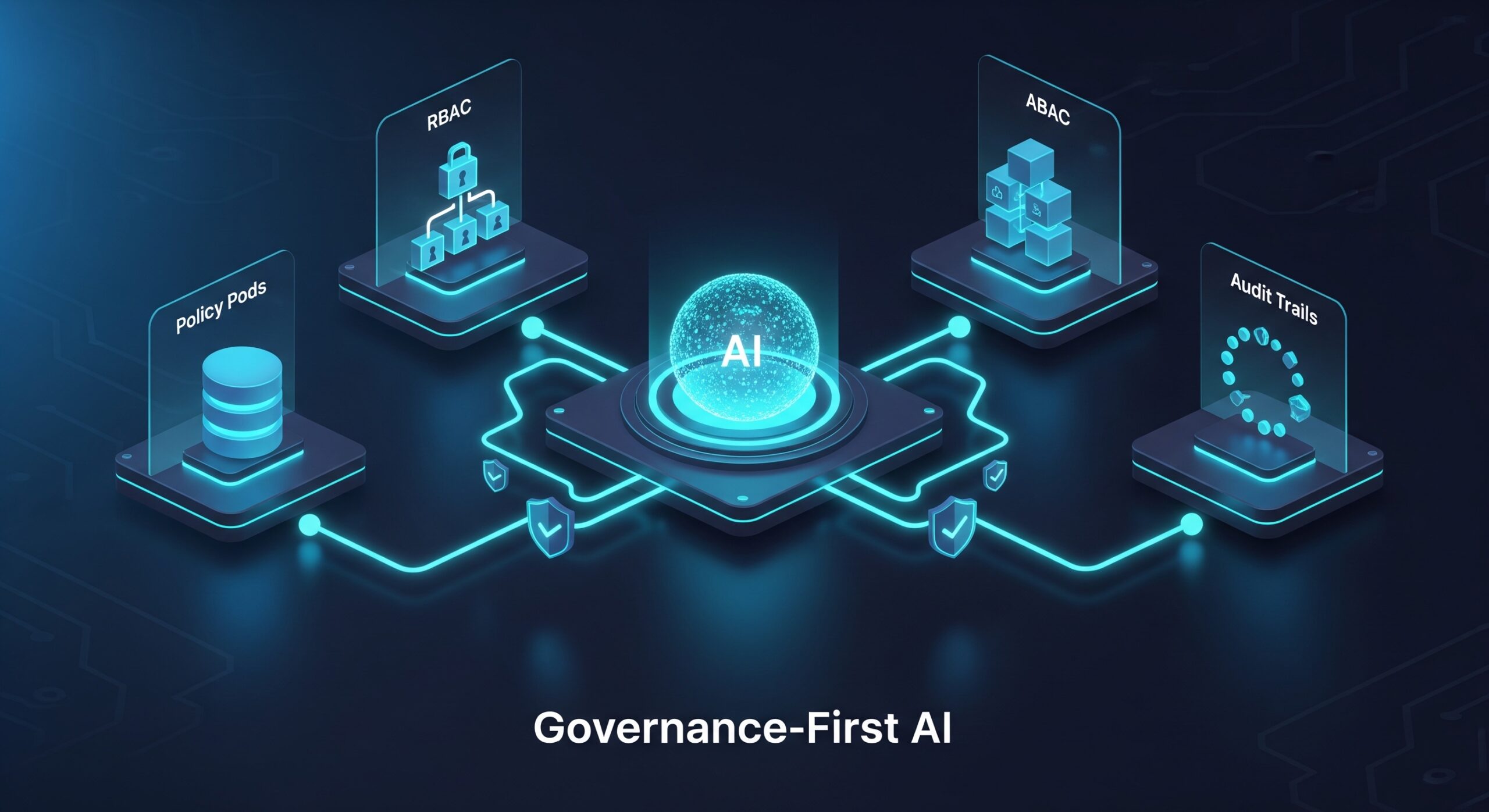
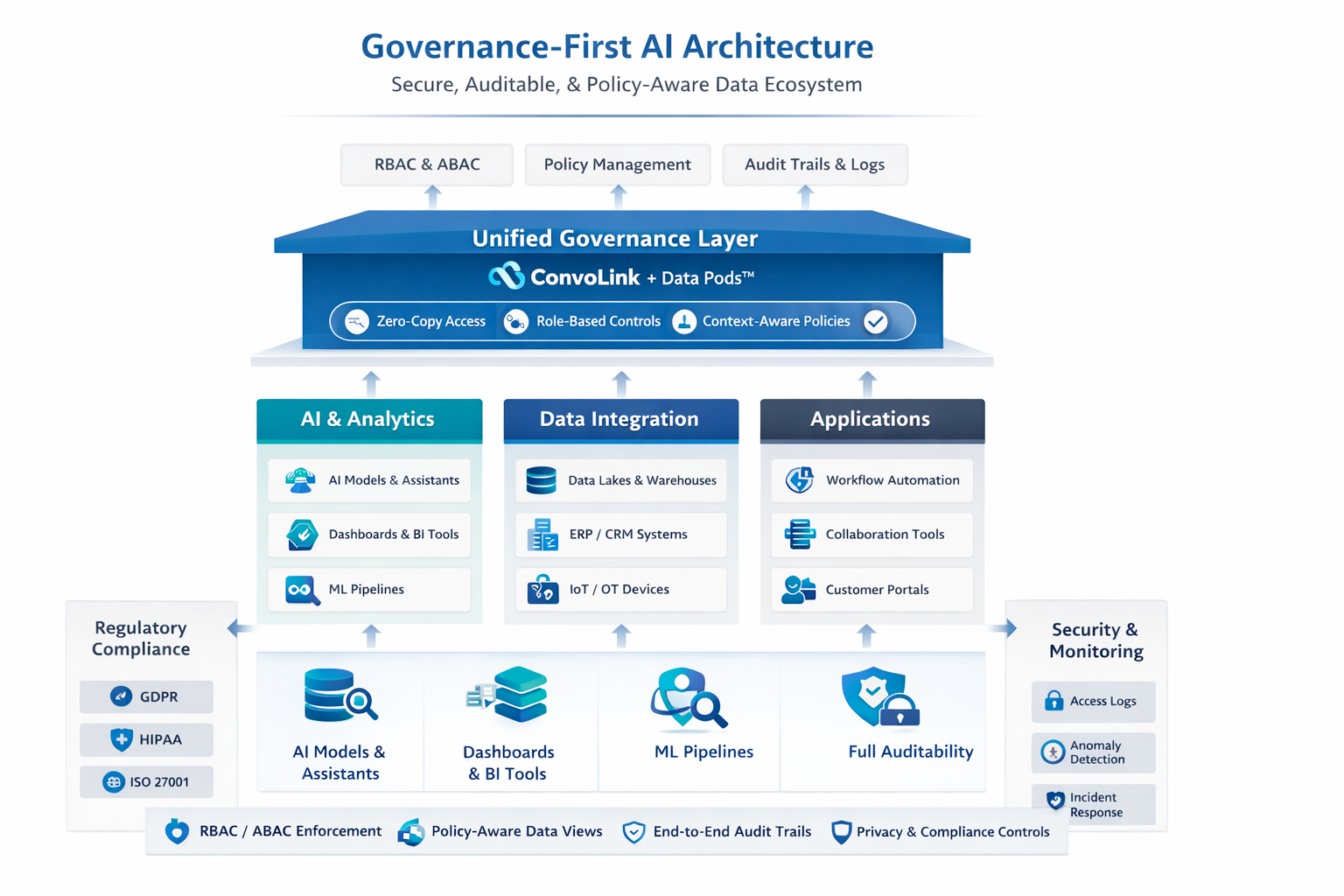
Governance-first AI combines three foundational elements:
Role-Based Access Control (RBAC)
Assigns permissions based on job functions. A loan officer sees loan data. A compliance analyst sees compliance data. Simple, scalable, auditable. Research shows RBAC frameworks achieve 99% security effectiveness by mitigating unauthorized access.
Attribute-Based Access Control (ABAC)
Adds context. The same loan officer might access customer records only during business hours, from approved devices, within their assigned region. ABAC evaluates user attributes, resource sensitivity, and environmental conditions in real-time.
Policy-aware Data Pods
Instead of copying data across systems (creating sprawl and risk), logical data views enforce policies at the source. Access is governed by role, application context, and policy—with masking and redaction applied automatically. Change a policy once; it's enforced everywhere, instantly.
The result: a hybrid model where RBAC provides the baseline structure and ABAC adds dynamic, contextual intelligence. Every action is logged. Every decision is traceable. And teams never wait for permissions that should already exist.
4. Three Use Cases by Segment
BFSI: Compliance at Scale
A leading Indian private bank deployed AI-powered customer service agents handling millions of interactions monthly. The challenge: ensuring PII protection while enabling personalization.
With RBAC/ABAC governance, relationship managers see full customer profiles. Service agents see masked account numbers and limited history. AI models access aggregated, anonymized data for training. The RBI's FREE-AI framework requirements—fairness, transparency, interpretability—are met by design, not afterthought.
Result: 60% faster audit preparation, zero PII exposure incidents, and full regulatory alignment.
Manufacturing: Protecting Operational Intelligence
A global automotive manufacturer implemented predictive maintenance AI across 47 factories. Plant engineers needed real-time access. Corporate analysts needed aggregated insights. Third-party vendors needed limited diagnostic data.
Policy-aware access ensured each group saw exactly what they needed—no more, no less. Equipment telemetry stayed on-premise; derived insights flowed to dashboards. Audit trails tracked every query across the network.
Result: 34% reduction in unplanned downtime with zero operational data leakage to unauthorized parties.
Healthcare: Patient Privacy Meets AI Innovation
A hospital network in Southeast Asia deployed clinical decision support AI. Doctors needed patient histories. Researchers needed anonymized cohorts. Administrators needed utilization metrics.
ABAC policies enforced HIPAA-equivalent controls: clinical data accessible only to treating physicians, during active care episodes, from authenticated hospital systems. Research queries automatically returned de-identified datasets.
Result: AI-driven diagnostic support improved accuracy by 23% while maintaining 100% patient privacy compliance.
5. Checklist: Your Next Steps
Before scaling AI, answer these questions:
Have you mapped who needs what data, under what conditions, for which use cases?
Are you combining role-based simplicity with attribute-based precision?
Can you produce a complete access history for any user, any resource, any timeframe—in minutes, not weeks?
When compliance requirements change, does enforcement follow immediately—or after manual updates across systems?
Are you eliminating data sprawl through logical access rather than physical replication?
As you adopt multiple AI models, can your governance layer manage access consistently across all of them?
If you answered "no" to any of these, you're not ready to scale AI safely.
Ready to Move from Pilot to Production?
At AXS Solutions, we've helped Fortune 500 enterprises across BFSI, manufacturing, and healthcare implement governance-first AI through our ConvoLink platform—featuring patented Data Pods technology with fine-grained RBAC/ABAC, centralized audit trails, and policy-aware access that moves at the speed of business.
The enterprises winning at AI aren't the ones moving fastest. They're the ones moving fastest with confidence.
Let's explore how your organization can scale AI without sacrificing security, compliance, or speed.
Book a 30-Minute Discovery Call →No pitch. No pressure. Just a focused conversation about your governance challenges and what's possible.